Table of Contents
- Introduction: Why Battle Ropes Are Your New Cardio Best Friend
- What Makes Battle Ropes Perfect for Short Cardio Sessions?
- How to Structure a Quick Battle Rope Workout
- The 6 Battle Rope Exercises
- Sample 10-Minute Battle Rope Cardio Circuits
- Common Battle Rope Mistakes to Avoid
- How to Scale Any Battle Rope Exercise
- What to Do After Your Short Cardio Session
- Conclusion: Short on Time, Big on Sweat
- FAQs About Battle Rope Exercises for Short Cardio Sessions
6 Battle Rope Exercises for Short Cardio Sessions
You know those days when your schedule is packed tighter than a suitcase after a holiday trip? You want to move, sweat, and feel alive, but a 45-minute workout sounds impossible. That’s where battle ropes come in. They’re thick, heavy, and look a little intimidating, but they’re basically a cardio cheat code for people with limited time.
I’m talking about short, intense sessions that leave you breathing hard and feeling accomplished. You don’t need a fancy machine or a packed gym. All you need is a set of ropes, a little floor space, and the willingness to look a bit wild for 10 to 15 minutes. Let’s dive into six battle rope exercises that turn tiny pockets of time into serious heart-pumping work.
What Makes Battle Ropes Perfect for Short Cardio Sessions?
Battle ropes are like the espresso shot of cardio. They deliver a fast, powerful hit without requiring a long warm-up or complicated setup. You grab the ends, create waves, and your heart rate climbs almost immediately. That’s because your upper body, core, and legs all pitch in at the same time. Your body can’t help but respond.
Another reason they shine in short sessions is the intensity dial. You can go all-out for 20 seconds, rest for 20, and repeat. Or you can keep moving steadily for 60 seconds. The ropes don’t care about your fitness level; they meet you where you are. They’re also low-impact on your joints compared to sprinting or jumping, which is a big win if you want sweat without sore knees.
Plus, battle ropes are forgiving. You don’t need perfect technique to get a good workout. You need to move your arms fast, stay low, and breathe. That simplicity makes them ideal for busy mornings, lunch breaks, or evenings when motivation is running low.
How to Structure a Quick Battle Rope Workout
A short cardio session works best when it has a clear shape. Think of it like a sandwich: warm-up bread, a filling of hard work, and a cool-down slice. Without that structure, you might burn out too fast or feel stiff afterward.
Warm-Up First (2 Minutes)
Don’t skip this. Two minutes of arm circles, shoulder rolls, bodyweight squats, and light jumping jacks will wake up your joints. Your shoulders and hips take a beating during rope work, so give them a heads-up. You can also do 20 seconds of easy alternating waves with the ropes just to feel the rhythm.
Work-to-Rest Ratios That Actually Work
For short cardio, I like three main ratios. If you’re new, try 20 seconds of work and 40 seconds of rest. That gives you time to catch your breath and keep form. If you’re comfortable, flip it to 30 seconds of work and 30 seconds of rest. If you want to feel like a superhero, do 40 seconds of work and 20 seconds of rest.
Repeat each exercise for 3 to 5 rounds. Total time? Anywhere from 8 to 15 minutes. That’s short enough to fit into a lunch break, but intense enough to count as real cardio.
The 6 Battle Rope Exercises
These six moves cover the whole body. You’ll hit your shoulders, arms, core, glutes, and legs. Mix and match them, or do them in order. The goal is to keep moving and keep breathing hard.
1. Alternating Waves
How to Do It
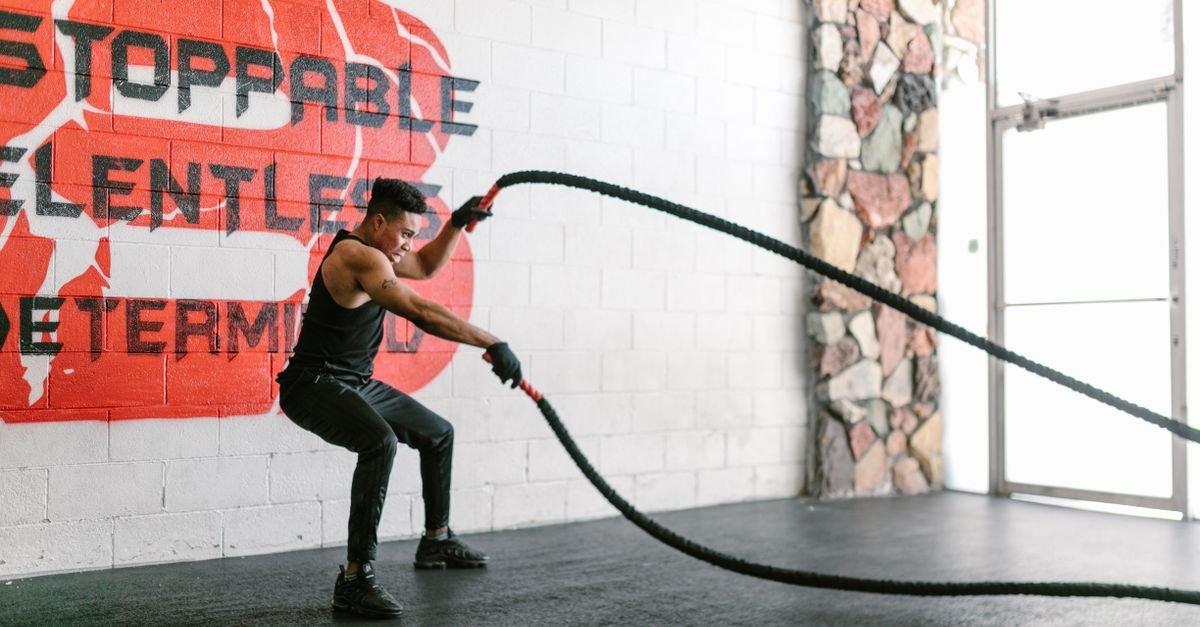
Stand facing the rope anchor with your feet shoulder-width apart. Hold one rope end in each hand. Bend your knees slightly and hinge forward at the hips. Now lift one arm and lower the other, creating a wave that travels down the rope. Alternate quickly, like you’re drumming on a table. Keep your core tight and your breathing steady.
Why It Fires Up Your Cardio
Alternating waves are the classic battle rope move. They’re simple, but they force your shoulders and arms to work nonstop. Your heart rate rises because your muscles are demanding oxygen fast. It’s like sprinting with your upper body. You’ll feel it in your lungs before you know it.
2. Double Waves
How to Do It
Same stance as alternating waves, but this time move both arms up and down together. The ropes should move like two parallel snakes. Keep your elbows slightly bent and your chest up. Don’t let your shoulders shrug toward your ears. Drive the movement from your hips and core, not just your arms.
Why It Fires Up Your Cardio
Double waves are a step up in intensity. Because both arms work at once, your body needs more energy. That means a bigger spike in heart rate and a bigger burn. It’s also great for coordination. If you’re short on time, double waves give you more bang for your buck.
3. Slams
How to Do It
Hold both rope ends in your hands. Raise them above your head, then slam them down toward the floor as hard as you can. The ropes should hit the ground with a satisfying thud. As you slam, bend your knees and hinge at your hips. Then pick the ropes back up and repeat. Keep your back flat and your core braced.
Why It Fires Up Your Cardio
Slams are explosive. They recruit your lats, shoulders, and core in a big way. Every slam is like a mini power clean without the barbell. The stop-and-start nature keeps your heart rate bouncing, which is perfect for short intervals. You’ll feel like you’re chopping wood, but the only thing you’re building is fitness.
4. Rope Snakes (Side-to-Side Whips)
How to Do It
Stand with your feet wider than shoulder-width. Hold the rope ends and lower into a quarter squat. Now whip the ropes side to side, so they move like snakes across the floor. Your arms should stay relatively straight, and the power should come from your hips and core. Keep your chest lifted and your eyes forward.
Why It Fires Up Your Cardio
Rope snakes are sneaky. They don’t look as intense as slams, but they light up your obliques and hip flexors. The side-to-side motion also challenges your balance. Because you’re staying low, your legs get a constant isometric burn. It’s a full-body cardio move that feels like dancing with a heavy rope.
5. Lateral Wave Lunges
How to Do It
Start with the ropes in your hands and your feet together. Step to the right into a lateral lunge, then push back to center. As you move, keep the ropes waving. You can do alternating waves or double waves. The key is to maintain the rope rhythm while your legs work. Step left, then right, and repeat.
Why It Fires Up Your Cardio
This move adds a lower-body strength component to your cardio. Your quads, glutes, and adductors get involved, which means more muscle mass is working. More muscle working equals more oxygen needed. That translates to a higher heart rate and a bigger calorie burn. It’s like adding a hill to your run, but you’re standing in one spot.
6. Grappler Toss
How to Do It
Hold both rope ends in one hand, or hold one end in each hand if you prefer. Rotate your torso to one side, then explosively throw the ropes across your body to the other side. Think of a grappler throwing an opponent. Your hips should rotate, your core should twist, and your arms should follow. Alternate sides with control.
Why It Fires Up Your Cardio
The grappler toss is a rotational powerhouse. It hits your obliques, shoulders, and back. Because it’s explosive, it spikes your heart rate quickly. It also feels athletic and fun, which matters when you’re short on time. If you’re bored with regular waves, this move wakes you up fast.
Sample 10-Minute Battle Rope Cardio Circuits
Here are three circuits you can try. Each one uses the exercises above. Do each move for the listed work time, rest as noted, and repeat the circuit for the stated number of rounds. Adjust as needed.
Beginner Circuit
- Alternating Waves: 20 seconds work, 40 seconds rest
- Double Waves: 20 seconds work, 40 seconds rest
- Rope Snakes: 20 seconds work, 40 seconds rest
- Rest 60 seconds
- Repeat 2 to 3 rounds
Intermediate Circuit
- Alternating Waves: 30 seconds work, 30 seconds rest
- Slams: 30 seconds work, 30 seconds rest
- Lateral Wave Lunges: 30 seconds work, 30 seconds rest
- Grappler Toss: 30 seconds work, 30 seconds rest
- Rest 60 seconds
- Repeat 2 rounds
Advanced Circuit
- Double Waves: 40 seconds work, 20 seconds rest
- Slams: 40 seconds work, 20 seconds rest
- Grappler Toss: 40 seconds work, 20 seconds rest
- Alternating Waves: 40 seconds work, 20 seconds rest
- Rest 45 seconds
- Repeat 3 rounds
Common Battle Rope Mistakes to Avoid
Even short workouts can go wrong if you ignore the basics. One big mistake is standing too tall. When you stand upright, your lower back takes the load. Bend your knees, hinge at the hips, and keep your chest proud. Another mistake is using only your arms. Your arms are just the messengers. The power should come from your hips, legs, and core.
Don’t hold your breath, either. It’s tempting to grit your teeth and power through, but breathing keeps your muscles supplied with oxygen. Exhale on the hardest part of each move. Also, don’t grip the ropes like you’re holding onto a cliff edge. A relaxed grip saves your forearms and lets you last longer.
Finally, don’t skip rest. Short cardio is not about going nonstop until you collapse. It’s about quality intervals. Rest is what lets you hit the next round hard. If you’re gasping for air and your form falls apart, take a few extra seconds. You’ll still get a great workout.
How to Scale Any Battle Rope Exercise
Battle ropes are adaptable. If an exercise feels too easy, move faster, stand lower, or use heavier ropes. If it feels too hard, slow down, stand taller, or use lighter ropes. You can also shorten your work intervals and lengthen your rest. There’s no shame in scaling. The best workout is the one you can repeat without dreading it.
Another way to scale is to change your stance. A wider stance gives you more stability. A narrower stance challenges your balance. You can also alternate between single-arm and double-arm versions. For example, if double waves fry your shoulders, switch to alternating waves. If alternating waves feel too easy, switch to double waves.
Listen to your body. If your lower back starts to ache, check your hinge. If your shoulders burn in a bad way, relax your grip and shake out your arms. Short sessions are supposed to be intense, not painful.
What to Do After Your Short Cardio Session
You just worked hard, so give your body a few minutes to come down. Walk around, shake out your arms, and take slow, deep breaths. A gentle stretch for your shoulders, chest, and hips can help you feel less tight later. Drink water. You lost fluids, even in 10 minutes.
If you have time, jot down how you felt. Did you hit a new personal best? Did an exercise feel awkward? Tracking your sessions helps you progress. Next time, you can add 5 seconds of work, reduce rest, or try a heavier rope. Small tweaks lead to big gains.
And don’t underestimate the power of consistency. A 10-minute battle rope session three times a week beats a 60-minute session you never do. Short cardio is about showing up, sweating, and moving on with your day.
Conclusion: Short on Time, Big on Sweat
Battle ropes are a gift for anyone with a busy schedule. They turn a tiny window of time into a full-body cardio blast. You don’t need a lot of space, a lot of equipment, or a lot of motivation. You just need to pick up the ropes and start moving.
Try alternating waves, double waves, slams, rope snakes, lateral wave lunges, and grappler tosses. Mix them into circuits that fit your fitness level. Warm up, work hard, rest smart, and cool down. Before you know it, you’ll be sweaty, energized, and proud that you fit a real workout into a crazy day.
So the next time you think you don’t have time to exercise, grab those ropes. Ten minutes is all it takes to feel stronger, faster, and a whole lot more alive.
FAQs About Battle Rope Exercises for Short Cardio Sessions
Can I do battle rope exercises every day?
You can, but I wouldn’t recommend going all-out every single day. Battle ropes are intense, and your shoulders, arms, and core need recovery. If you love them, alternate hard sessions with easy ones, or do them three to four times per week. Listen to your body. If you’re sore or fatigued, take a rest day or do a lighter activity like walking.
How long should a short battle rope cardio session last?
Most short sessions land between 8 and 15 minutes. That includes your warm-up and cool-down. The main workout might be 6 to 10 minutes of intervals. If you’re a beginner, start with 5 minutes of work and build up. If you’re advanced, 15 minutes of hard intervals is plenty to get a serious sweat.
What if I don’t have battle ropes?
You can still get a similar effect with a heavy resistance band, a towel, or even a long jump rope. You won’t get the exact same wave motion, but you can mimic the arm and core work. Try fast punches with light dumbbells, shadow boxing, or medicine ball slams. The goal is to move intensely and elevate your heart rate.
Do battle ropes build muscle or just cardio?
They do both, but they lean more toward cardio and muscular endurance. The ropes are not heavy enough to build massive muscle like heavy squats or bench presses. However, they do strengthen your shoulders, arms, core, and legs. If you want more muscle, pair battle ropes with resistance training. If you want conditioning, they’re perfect on their own.
How many calories can I burn in 10 minutes with battle ropes?
It depends on your weight, intensity, and fitness level. A rough estimate is 10 to 15 calories per minute, so 10 minutes could burn 100 to 150 calories. Some people burn more, some less. The real benefit is the afterburn effect. Your body keeps burning extra calories for a while after the workout. Plus, you’re building cardiovascular fitness, which helps you burn more calories all day long.



